
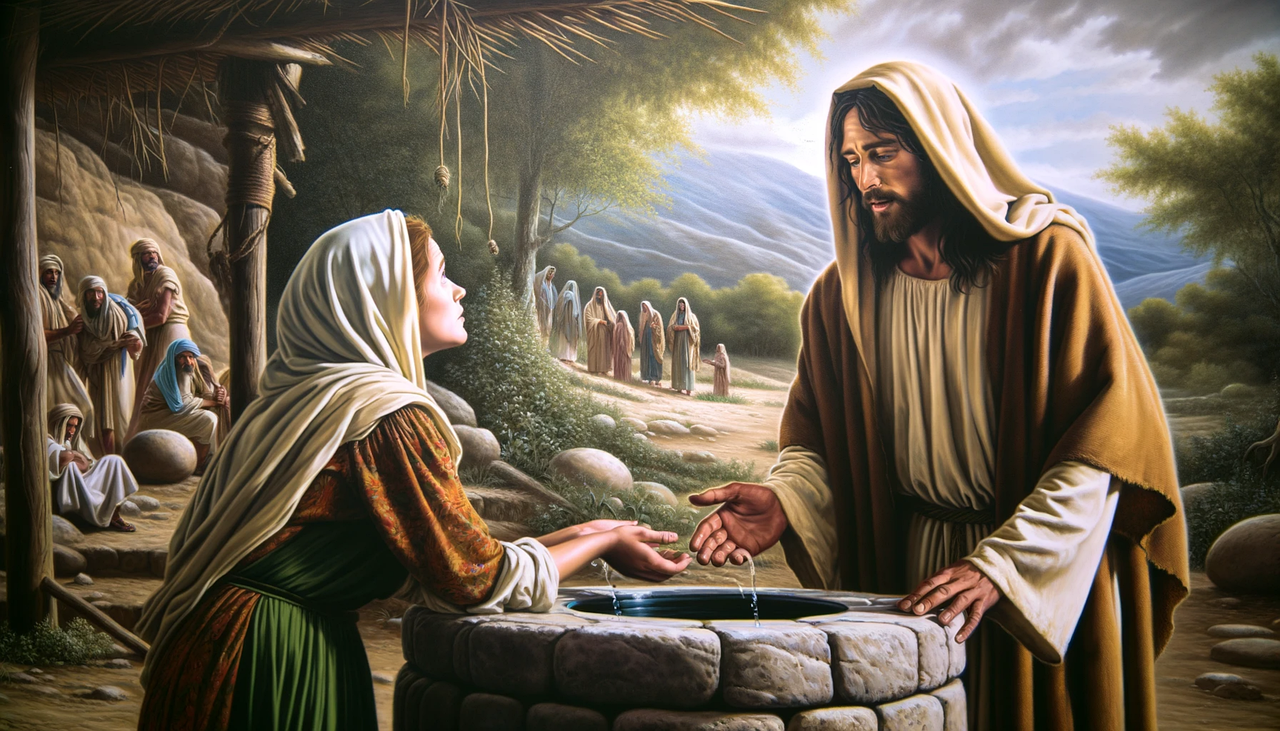
This third Sunday of Lent we read the Gospel of John Chapter 4. It is the meeting between Jesus and the Samaritan woman at Jacob’s well. It is the first of three accounts chosen from John’s Gospel which are selected in Lent for the themes of conversion, baptism, and new life. Let me give this set of points to emphasize, about all three Gospels.
- John 4 – the Samaritan woman meets Jesus at the well, and comes to believe his word that he is the Messiah. She then starts to speak openly about this incredible new thing that has happened in this meeting.
- John 9 – Jesus heals the man born blind, who not only comes to see with his natural eyes, but – even better – encounters salvation by coming to believe that Jesus is the Savior. And we get to “see” clearly the pride of Jesus’s opponents, who pride themselves on knowing more than everyone, but who can’t “see it” when a verifiable miracle happens in front of them.
- John 11 – Jesus raises Lazarus from the dead after 4 days in the tomb, showing a sign that his power to give life, and transform lives, is supreme and unconquerable. (We note that Jesus is the only person ever to hold this power in his own name.)
These points are not simply helpful to emphasize. They are essential to our faith. Jesus is the Messiah that God promised to the Jewish people. Jesus is the savior, and we must put our faith in him. Jesus is the only path to eternal life, and if we harden our hearts to the signs that he has given, we risk the eternal despair and punishment of sin.
Here we must examine the first Gospel more closely. It is all fine and good to hear about this woman in Samaria who met Christ at Jacob’s well, at noonday while fetching water. How happy for her that Jesus offered her “living water” (including forgiveness) despite her abysmal failure at finding joy and fulfillment in life. But what about you and me? Can we really meet Jesus in the same way? If we did, would we admit that we are not fulfilled in life, or would we try to keep the conversation superficial apart from our deepest longings or regrets?
Can we meet Jesus? If we can, then how? A short answer is to say that everyone who meets Jesus meets him through the Church. And people do meet Jesus through the Church, which is His Body on earth. This is what the Church is always saying, we are the Body of Christ on earth. You can’t meet Jesus apart from his body. If at any time in your life you became convinced that Jesus of Nazareth, “who was crucified under Pontius Pilate… and rose again on the third day,” is not only alive but was in fact giving some heavenly message or grace… to you… directly… intensely… and personally… then you know what I am talking about. This did not come out of nowhere. It was possible because there were many Christian believers, or just one Christian believer, who had been like a hand or a voice or a set of guiding feet leading to that experience.
As I say this, let me describe one particular scenario where it often happens that a person becomes convinced that Jesus is truly the savior – the person even comes to pray to Jesus for forgiveness of sins – but yet no other Christian has been there to be the “guiding feet” or the “voice” of Jesus in this process. Of course, I am speaking about when a person has some feeling that maybe they need to search for God or return to God, and then starts to read the Bible on their own. There is much history that this question brings up. But we must summarize it very briefly. We must realize that the Church existed first, and then it was Jesus and the Holy Spirit who worked through the Church to get the Gospels and the epistles written. In short, the Body of Christ from back then, gave us the Bible today. People do meet Jesus in a profoundly novel way by reading the Bible. But this way is not apart from the Church. Here also what I have said proves true. Even today, everyone can in fact meet the Messiah and Savior, and whether it be through experiences involving a priest, a lay Catholic, a Protestant Christian, or a printed Bible which owes its existence to those Apostolic Christians who completed its writing about 1900 years ago, it is always through the Church.
Now, of all the people here and now who are helping to introduce more people to Jesus, are there any doing it because they are personally as worthy as Jesus and as holy as Jesus? Definitely not! But with this Scrutiny we note that the Samaritan woman was definitely not as worthy as Jesus and as holy as Jesus. But she immediately started to tell more people about him, and Jesus was happy about it. If we have met Jesus, if we have encountered any sign that his power is real (be that something we deem miraculous, or just so personally-providential we know it has a divine power behind it) then we can immediately speak to others from the standpoint of this faith: “I encountered someone who knew everything about me.”
But have we met Jesus? Have you met Jesus?
I want to share what might be a typical experience of many Catholics who grow up as Catholics. I call it typical, but it is certainly not all. Some Catholics grow up encountering all the Catholic sacraments and prayers and practices, and they live as children with a general acceptance that these things do connect us with God. But this connection is not very personal. There is an impression that “Jesus is real,” or “we can talk to God the Father,” and so on. And yet, there is no feeling that the response to prayer is personal. It is always general, applicable to everyone, but never individualized.
I repeat that there are some Catholics who are not subject to this false impression when they are growing up. This is a beautiful and hopeful thing to affirm. Some children, even at the age of 8 or 9, not only start a life of prayer on their own, but they grow in an immediate understanding that God has a very specific interest in their lives.
Yet, for many others, for many reasons that God only could know fully, it is only later in life that they have a more intensely personal encounter with Jesus. The encounter makes the Catholic more prayerful, more open to sacrificial changes. It also makes them more compassionate. There is an intentional shedding of some sins of omission, or sins of commission. Knowing of how personally interested in their life Jesus actually is, they will work hard to drop a bad habit, or they will rearrange their priorities in life to start doing some good thing, which had previously attracted them but had not really “moved them.”
These changes are the result of an encounter with Jesus. A person might describe it in other terms, like “realizing the goodness of the Father,” or “encountering the power of the Holy Spirit.” But in all cases, it is an encounter with Jesus. The whole pattern is captured in the meeting at the well, of the Samaritan woman and her savior.
For many of us, we did truly encounter Jesus at our baptism, but we could not respond by any personal decisions if we were mere babies. And we do in reality encounter Jesus when we make a confession to a Catholic priest, and also receive Holy Communion at Mass. And still it can be that the relationship with God, in all the particularities of our lives, remains something we only think about as a general thing: an impersonal thing. For reasons that God only could know fully, our more intensely personal encounter with Jesus is yet to happen. We live in a paradox, where the encounter has happened, but something in us has kept us from allowing it to be as personal and life-transforming as Jesus wanted it to be. And so he has started planning another encounter. Start preparing your heart now, for when you are ready to listen, he will tell you “everything you have ever done,” and offer you living water so that you may never thirst.
For those who are about to be baptized, you have been preparing your mind, and we trust that you have been reaching out by trying to pray. Trust that God has been using already every effort you have made. We pray that you feel you have been trying to follow the path Jesus is personally laying out for you, knowing about it just a few months, or maybe for many years already. Consider that, if we could make comparisons about who has successfully completed more of their individual path, we who have been communing with the Body of Christ, are just slightly ahead of you, and certainly not too far separated as to say we shall have no interactions with you, as we seek a common destination.
Among the things Jesus is asking of me, here and now on the path he has chosen for me, is to support you, and pray for you. And among the things I know Jesus is asking of you, here on the path that he is revealing to you, will be to build a relationship and communion with us, and the whole Church, to safeguard all the Good, and every grace, that Jesus is giving, and will give to you.
 Ubi Petrus VT